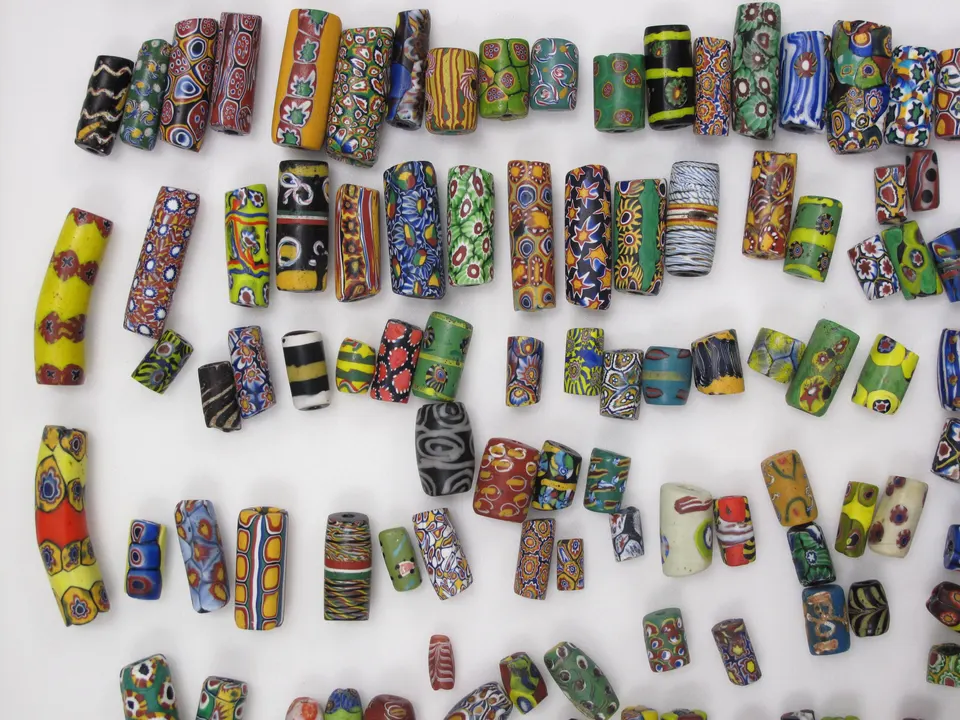
Murano glass beads fall into three main types: tiny seed beads cut from thin tubes, chevron beads with a star inside, and lampwork beads shaped one by one over a flame.
Main types of Venetian beads compared
| Type | How it is made | What to look for |
|---|---|---|
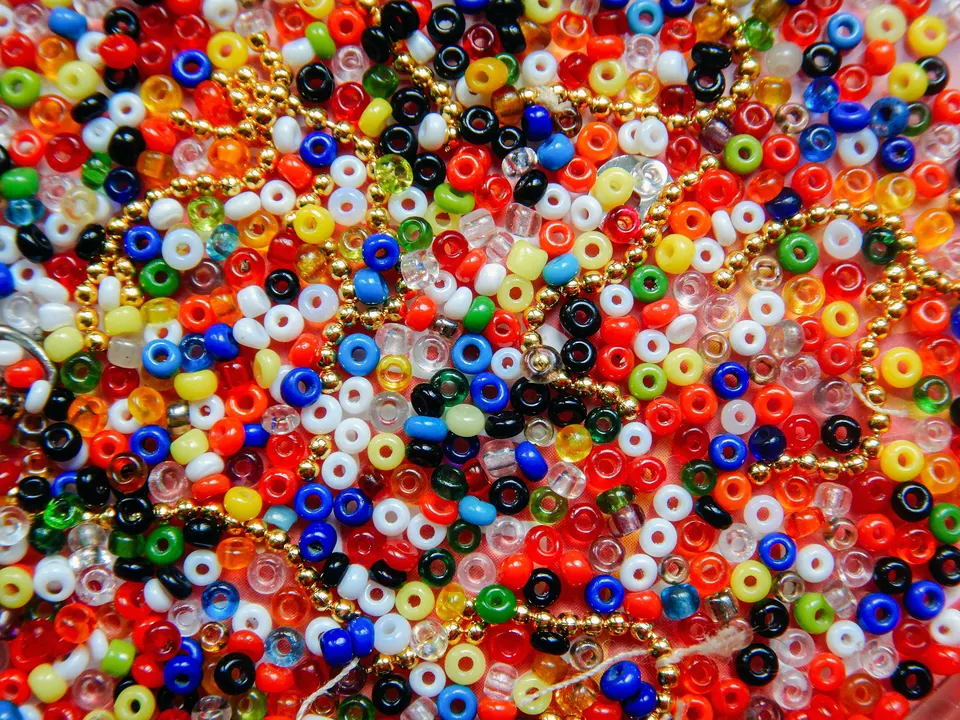
| Conterie (seed beads) | A hollow glass tube is pulled thin, chopped, and rounded with heat | Tiny, one color, very regular |
| Rosetta (chevron beads) | A hollow tube of several colored layers, some pressed in a star mold, is pulled, cut and ground | A star at the end, zigzags along the side; often blue, white and red |
| A lume (lampwork) | A glass rod is melted in a flame and wound around a metal wire | Each bead differs; dots, flowers, foil, threads |
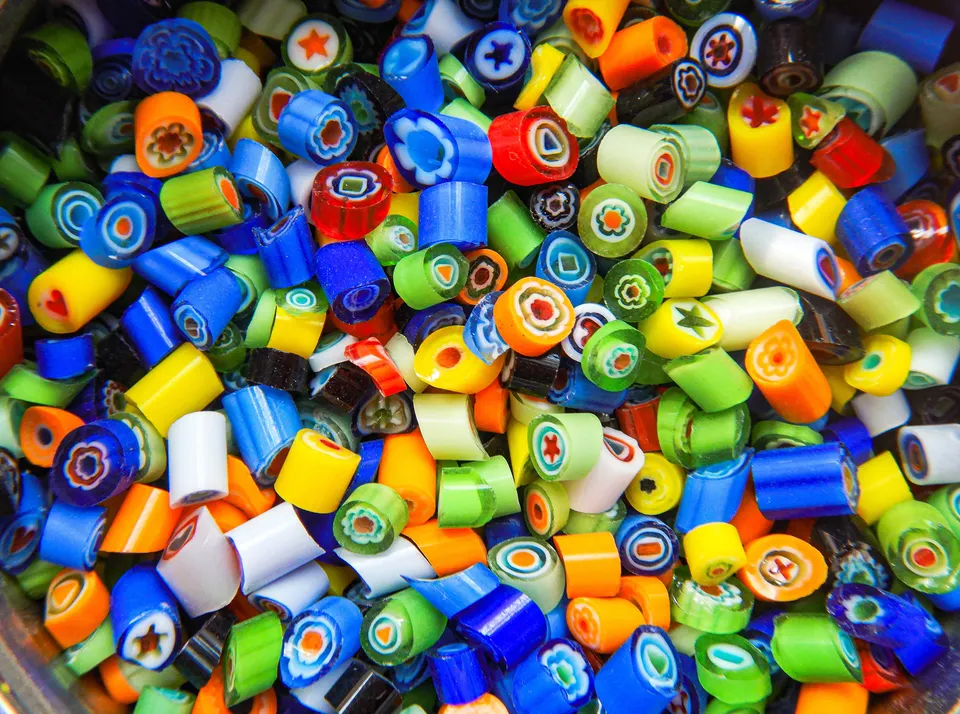
| Millefiori beads | Slices of patterned cane are laid on a glass core | Small flowers or stars all over |
Millefiori beads use the same kind of cane as vases and bowls. The canes are explained in murrine and millefiori.
How a lampwork bead is made
The maker holds a rod of glass in one hand and a metal wire in the other. The flame, once an oil lamp and now a gas torch, softens the rod. The glass drips onto the wire, which is turned all the time so that the bead stays round.
Then come the details: a layer of gold or silver leaf, a clear coat over it, thin colored threads, dots that become roses. Beads with such raised roses and swirls are called fiorato or wedding cake beads. The bead cools slowly, the wire is pulled out, and its place is the hole. The Museo del Vetro dates these beads in Venice from the 17th century. For the colors, read how color gets into glass.
How seed beads and chevron beads are made
Both start with a lump of hot glass with an air bubble inside. Two people pull it apart into a long, thin cane, and the bubble becomes a hole through the whole length. Canes of up to 60 meters are reported. The cane is chopped into short pieces, which are heated (since the 19th century in a turning drum) until their edges are round, then sorted through sieves.
For a chevron bead the lump gets several coats of color and is pressed into star-shaped molds before pulling. The ends are ground down, so the layers appear as a star and zigzags. The museum credits this bead to Marietta Barovier, a glassmaker's daughter, in the 15th century.
Who made the beads and where they went
Beads were made in Venice from the 14th century. In the hard years of the 19th century they were the one part of Murano's industry that grew. Women did much of the work. The impiraresse strung seed beads, sitting in the lanes with a box of beads on their knees.
Beads were shipped to Africa, the Americas and India. This trade has a dark side: European merchants also exchanged beads for enslaved people in Africa. Since 2020 the art of glass beads in Italy and France has been on the UNESCO list of intangible heritage. The wider story is in Murano glass history.
Is the bead from Murano?
The type does not prove the place. All these methods are used in other countries today. Beads are too small for most marks. Ask for the name of the workshop and the Vetro Artistico Murano label on the card or box, as described in signs of real Murano glass.
Old strings were often restrung and mixed. One string can hold beads of several ages, so look at each bead. Age and rarity are covered in what gives Murano glass value.
Sources
Main photo: Venetian trade beads. Photo: Unknown author, CC BY 4.0