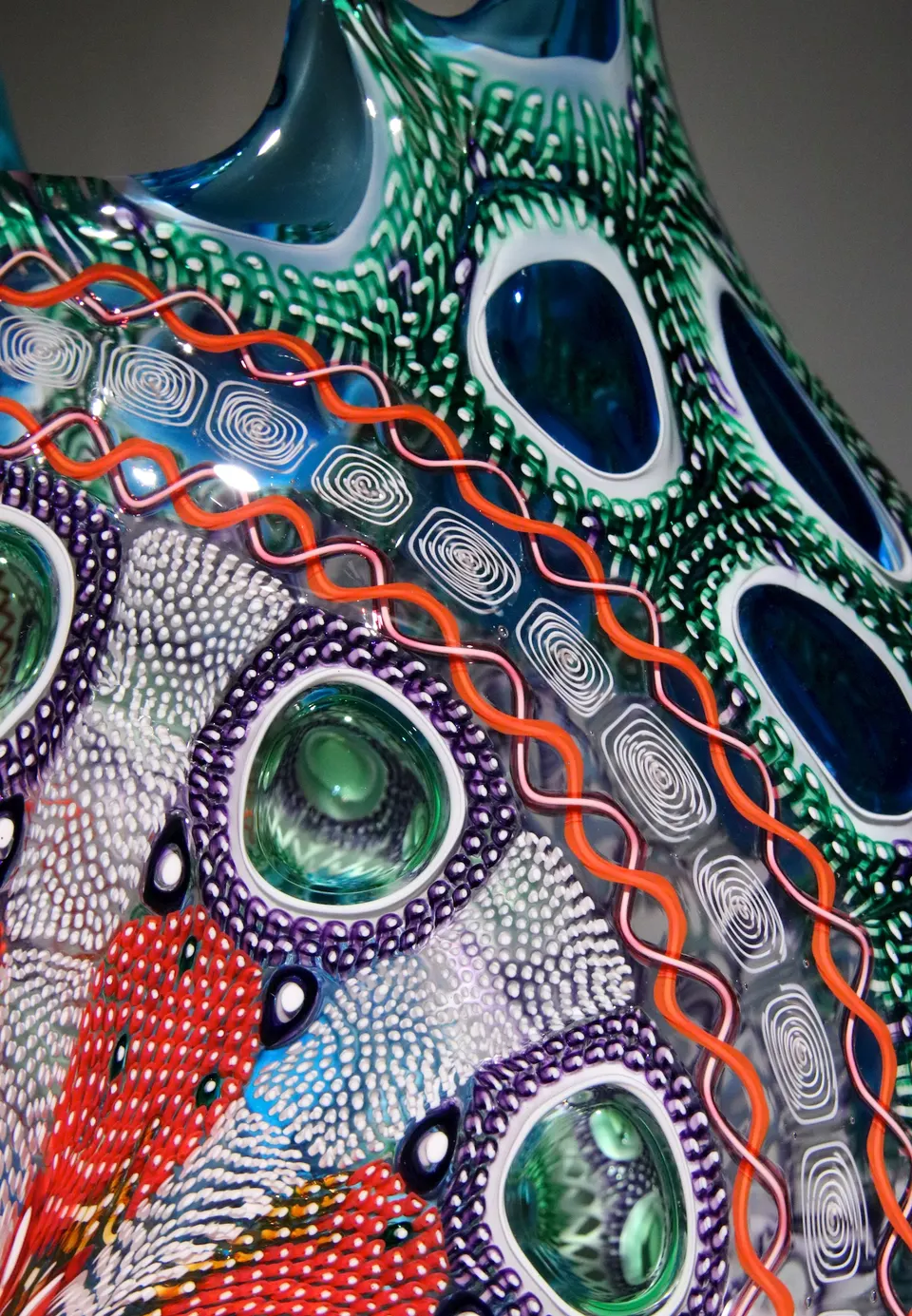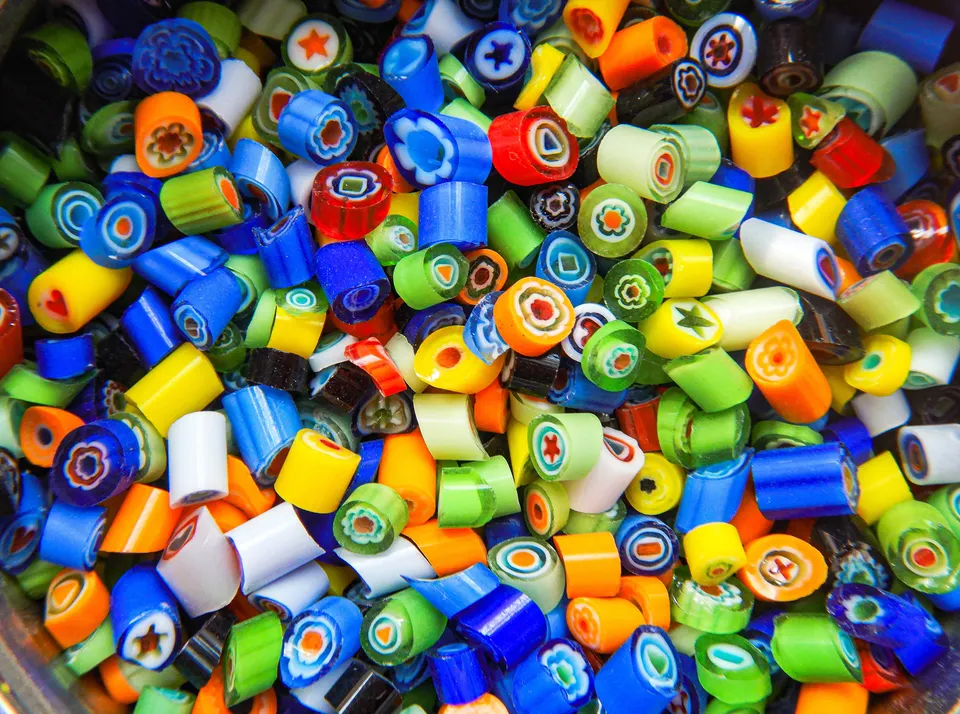
Millefiori glass is made of many small slices with a flower pattern. Each slice is called a murrina and is cut from a glass rod that carries the same picture along its whole length. Millefiori means “thousand flowers”.
How a murrina cane is made
The work starts with a short, thick lump. A core of one color is covered with a layer of another, rolled smooth, covered again. Pressed into a star-shaped mold between layers, the hot outer glass takes the points of the star and the cooler inside keeps its form. Several finished rods can be bundled and fused into a larger image.
Then it is pulled. Two people hold the hot lump between two iron rods and walk apart. The glass stretches into a cane about as thick as a pencil, and the drawing shrinks evenly with it. After it cools, the cane is cut across, and every slice carries the same picture.
How the slices become a vase
- Picked up hot: slices lie on a steel table and a glowing bubble is rolled over them, then blown further.
- Fused and rolled: slices are packed on a plate, melted into one sheet, wrapped around the end of a pipe, sealed and blown.
- Slumped: the fused sheet softens over or into a form and becomes a bowl. No blowing is involved.
Where millefiori comes from
Patterned canes were made in the Middle East more than four thousand years ago, and the Romans made mosaic bowls from them. Murano glassmakers took up mosaic glass in the 15th century. The method later faded and came back in the 19th, when the complex millefiori cane became a local specialty. The V&A in London keeps a green millefiori vase by the Venice and Murano Glass and Mosaic Company, made during that revival.
So millefiori by itself does not mean Murano. French and English factories made such canes too. For origin, go back to labels and documents.
Signs of good millefiori
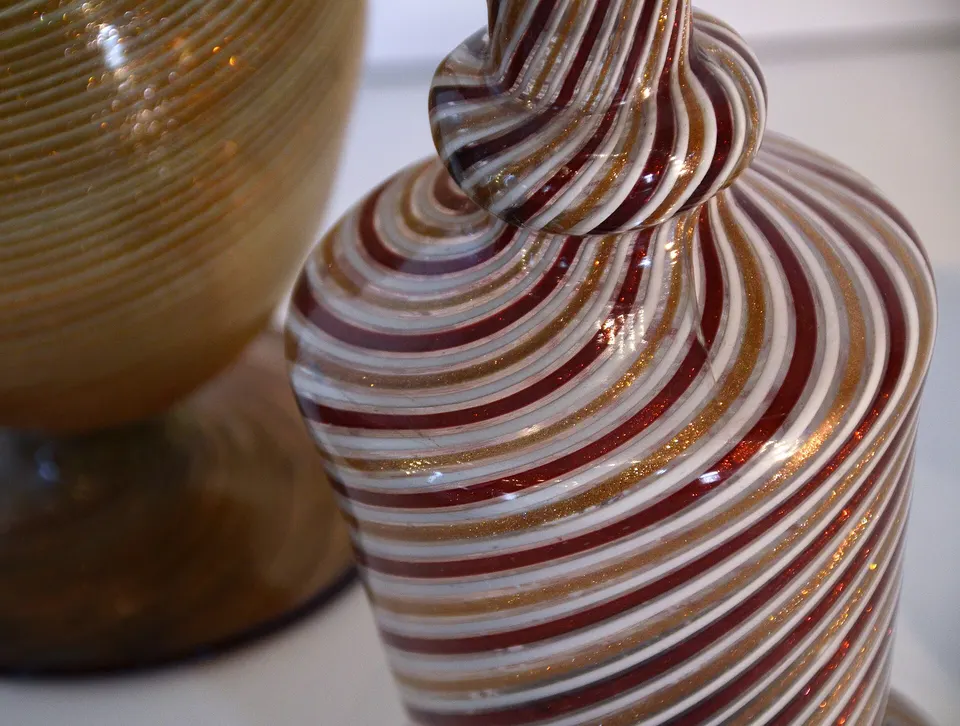
Slices should meet without gaps or dark pits. Where the vase was blown out, flowers grow larger and lose sharpness toward the belly, and that is normal. Colors should keep clean borders. Bleeding or muddy edges suggest overheating. Canes are also used lengthwise, for stripes and twists: see filigrana and reticello.
Sources
Main photo: Cut millefiori canes. Photo: Albarubescens, CC BY-SA 4.0