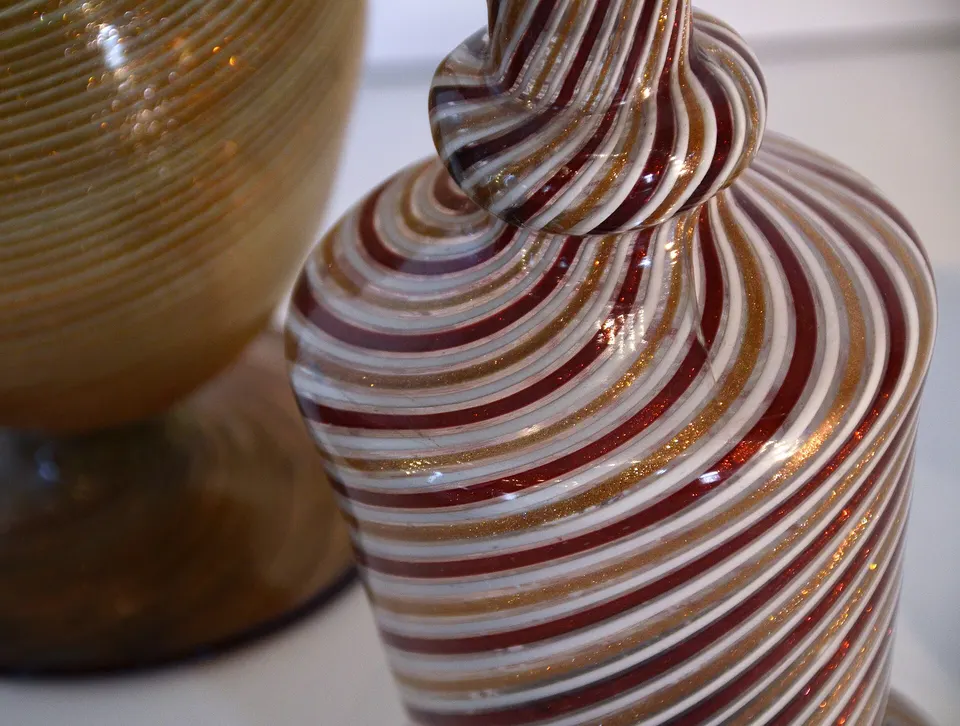
These eight Murano glass techniques cover most of what you will see in museums and shops. For each one you will find what the glassmaker does and the visible sign that gives it away.
Eight techniques and how to recognize them
| Term | How it is done | What to look for |
|---|---|---|
| Sommerso, "submerged" | Glass is dipped into pots of other colors, building thick transparent layers. | A colored core inside a clear, heavy outer coat. |
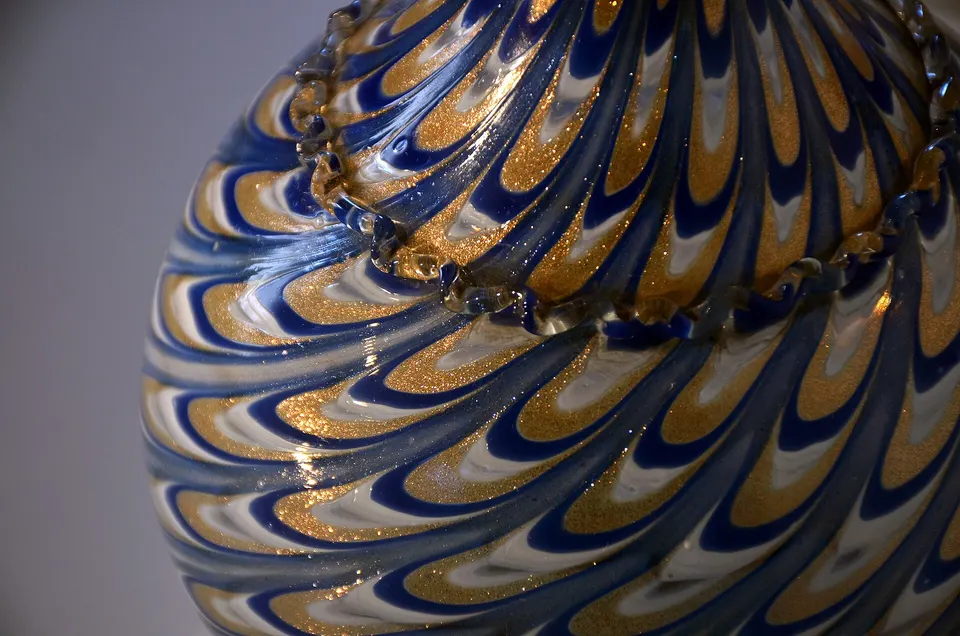
| Filigrana | Clear rods with white or colored threads are fused and blown. Twisted threads are called a retortoli. | Fine lines inside the wall, straight or spiral. |
| Reticello | Two threaded bubbles, twisted opposite ways, are joined one inside the other. | A net of small diamonds, classically with a tiny air bubble in every mesh. |
| Battuto, "beaten" | A cold surface is ground on a wheel in small marks set side by side. | A satin skin like hammered metal. |
| Incalmo | Separately blown parts are joined hot into one body. | A sharp line where one color ends and another begins. |
| Avventurina | Copper crystals grow in the cooling melt. | Brown glass with metallic sparkle. |
| Lattimo | An opacifier such as tin makes the glass white. | A milky wall that recalls porcelain. |
| Pezzato, "patchwork" | Strips of colored glass are cut up, fused into a sheet and rolled onto a clear gather. | Squares of color with softened edges. |
Which techniques are old and which are new
Lattimo was used for mosaics and enamels before it became blown ware in imitation of Chinese porcelain. Filigrana was developed on Murano in the first half of the 16th century. Sommerso, incalmo and pezzato belong to the 20th. Pezzato is tied to Fulvio Bianconi, who designed for the Venini workshop; the V&A has one of his patchwork vases. Carlo Scarpa used battuto on vases for the same firm.
More dates are in Murano glass history, and the general process is in how Murano glass is made.
Terms people mix up
People often call any crossed pattern reticello. Strictly it means two layers of threads running in opposite directions. Goldstone is another name for avventurina, and neither contains gold. Sommerso is also different from incamiciato, where a colored transparent layer lies over an opaque base. Incalmo and pezzato may look alike from a distance: the first has long bands, the second has patches.
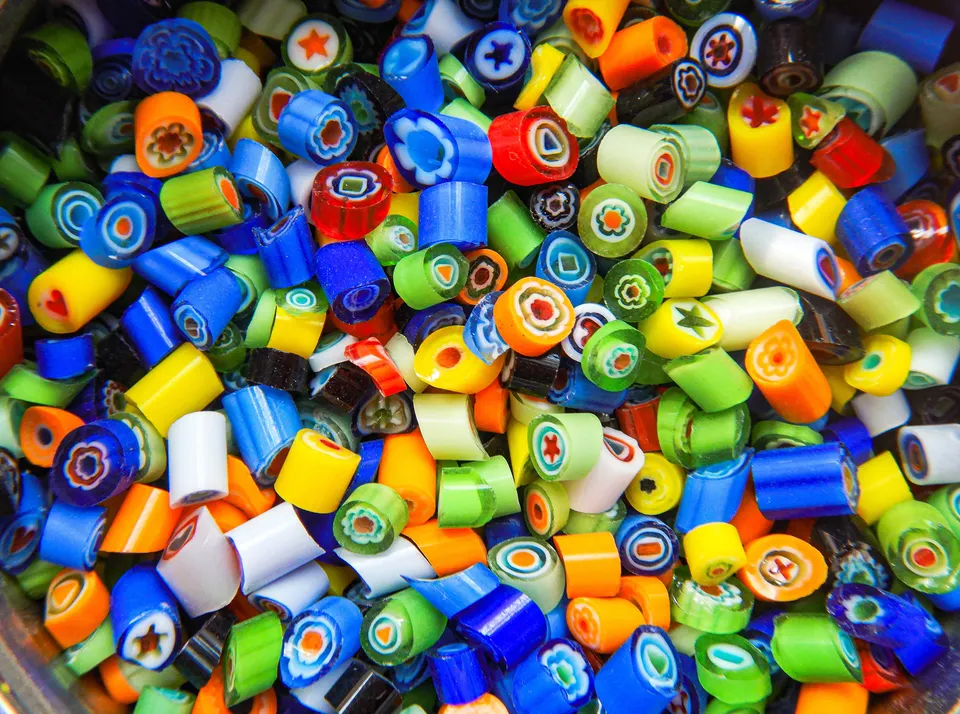
For the chemistry behind the colors see how color gets into glass. Patterns that run through a rod have a guide to millefiori glass.