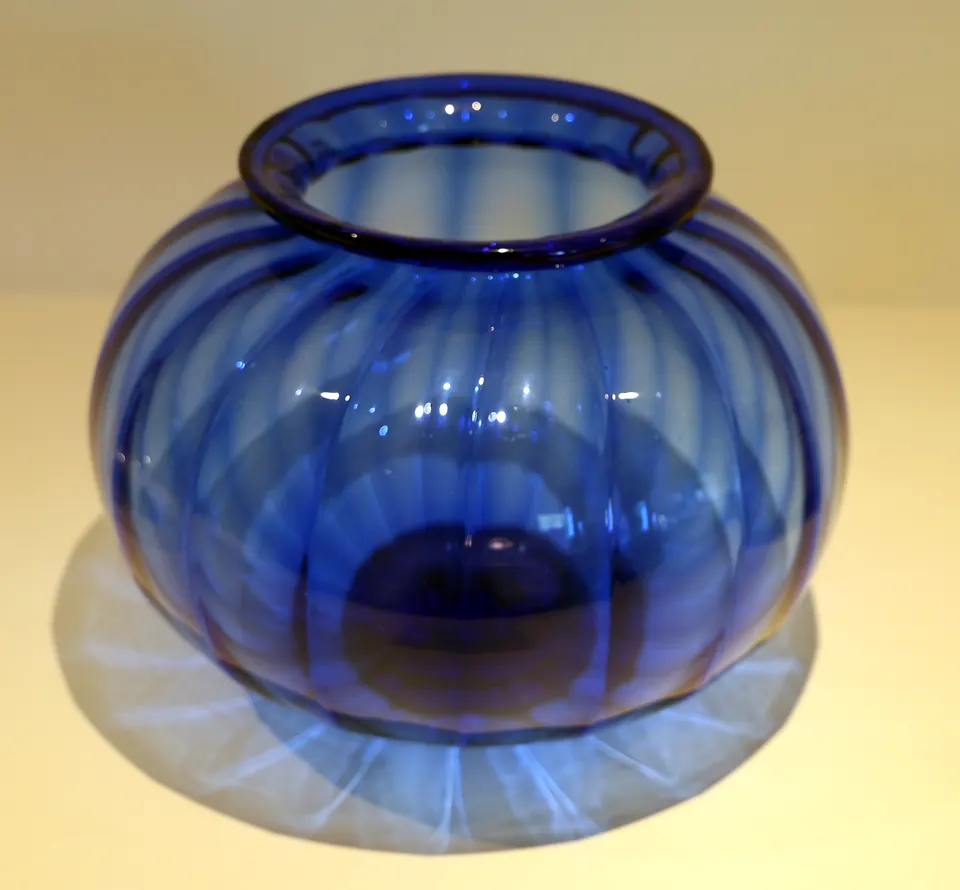
To tell if Murano glass is real, look for proof of origin: the Vetro Artistico Murano label with a maker’s code, a signature that matches a known workshop, or a documented purchase. Bubbles, a mark on the base or gold flecks show how a piece was made. They do not show where.
What the Vetro Artistico Murano label proves
Vetro Artistico Murano is a collective trademark set up by a law of the Veneto Region and run with the Promovetro consortium. It certifies origin: the object was made on the island in keeping with local tradition. It says nothing about whether you will like the design, and it does not grade quality.
The label is a small red or blue sticker with the words in gold leaf, a pair of glassmaker's tongs drawing out a plate, and the code of the workshop. The color follows the type of work. The sticker breaks into fragments when peeled, so it cannot travel to another vase.
The scheme covers only workshops that hold a license. A piece without a sticker may still be from Murano, especially an old one, and then you need other proof.
Is a signature enough?
Compare a scratched name or a paper label with documented examples from the same workshop. Look at the letter shapes, the position and the tool used. A signature alone is easy to copy, so it counts for more when the shape and technique also fit the maker.
Murano glass marks: labels, acid stamps and engraved names
Murano glass has no single national mark. Each firm used its own, and one piece may carry two or three. These examples are recorded by the V&A in London:
- Paper label. Venini: black and white, with “Venini Murano Venezia,” a number and “Made in Italy.” Barovier & Toso: red on silver or on white.
- Acid stamp. “Venini Murano Italia” on glass by several designers; “MVM Cappellin Murano” on a vase from 1930.
- Engraved by hand. “Vistosi 1971,” “Carlo Moretti,” “Ercole Barovier Murano 1951,” “Venini Italia TW 1968” for designer Tapio Wirkkala.
- Ground on a wheel. “Venini” on two bottles by Carlo Scarpa.
- Shop label. A Venini handkerchief vase carries only “Finmar,” which the museum lists as the retailer.
Some museum pieces have no visible mark. One real Venini vase has an acid mark that the V&A thinks was added recently. Marks also affect Murano glass value.
Signs that do not prove it is Murano
| What you see | What it really tells you |
|---|---|
| Pontil mark on the base | The vase was held on a rod while the mouth was finished. Glassblowers everywhere use one, and many good pieces have the mark ground flat. |
| A few air bubbles | Gas was left in the melt. Murano furnaces work to remove it. Some designs, such as pulegoso, are full of bubbles on purpose. |
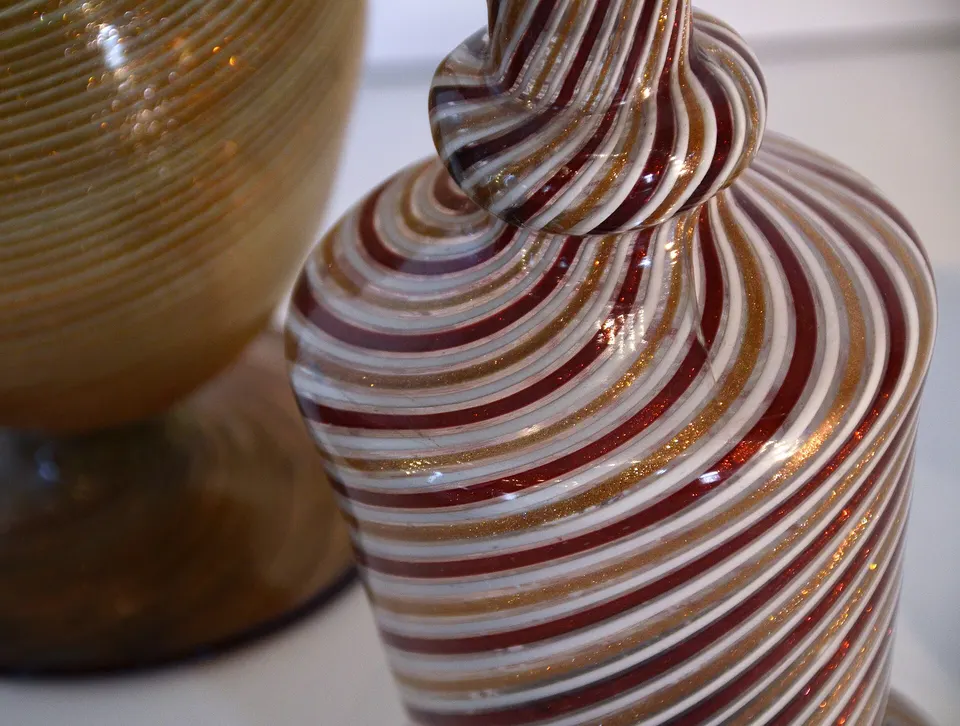
| Gold or silver flecks | Metal leaf, or copper crystals in avventurina. Both are used outside Murano. |
| Clean color layers | Skill in casing one glass over another, see sommerso. |
| Slight unevenness | Handwork of some kind, in any country. |
“Murano style” does not mean made in Murano
"Murano style" and "made by the Murano method" describe a look. They leave the place out. Imitations are common, and the usual visitor cannot spot them by eye, so ask for the origin in writing with the name of the workshop. Knowing how a vase is blown helps you ask better questions.
For the background, read Murano glass history.
Sources
- Murano Artistic Glass, Veneto Region
- Guide to the trademark Vetro Artistico Murano, Consorzio Promovetro (PDF)
- Glassmaking tools, with Glass Dictionary definitions, Corning Museum of Glass
- What Is Glass? Museo del Vetro, Murano (PDF)
- Venetian glass, Wikipedia
- Vaso a fili, Venini, V&A
- Vase, Barovier & Toso, V&A
- Vase, MVM Cappellin, V&A
- Vase, Vistosi, V&A
- Bottle by Tapio Wirkkala, Venini, V&A
- Vaso a velato a mola, Venini, V&A
- Handkerchief vase, Venini, V&A
- Inciso vase, Venini, V&A