Murano glass value depends on five things: who made it, who designed it, how rare it is, what condition it is in, and what papers prove it. Prices also move with the market.
Five things that decide the value
| Factor | What to look for |
|---|---|
| Maker | A named workshop, shown by a mark, a label or a catalog |
| Designer | A known person tied to that workshop and those years |
| Rarity | A short production, a difficult technique, few known pieces |
| Condition | No chips, cracks, scratches or repairs |
| Papers | Invoice, exhibition list, photo of the piece in a catalog |
Nobody can give one fixed price. The Smithsonian American Art Museum explains that prices depend on condition, on what buyer and seller want, and on trends.
Maker and designer: why names matter
In the 20th century several Murano firms worked with architects and artists. Venini, founded in 1921 as Cappellin Venini, invited Carlo Scarpa, Gio Ponti, Ettore Sottsass, Fulvio Bianconi and others. Museums such as the V&A keep these pieces and describe their marks, so a name can be checked.
A name on the base is a start. Form, technique and date must agree with it. The V&A lists a vase by Paolo Venini and Carlo Scarpa with an acid mark “probably applied recently.” The vase and the mark are two separate questions. Read how to tell real Murano glass before you rely on a mark. More on one designer: Carlo Scarpa.
What makes a Murano piece rare
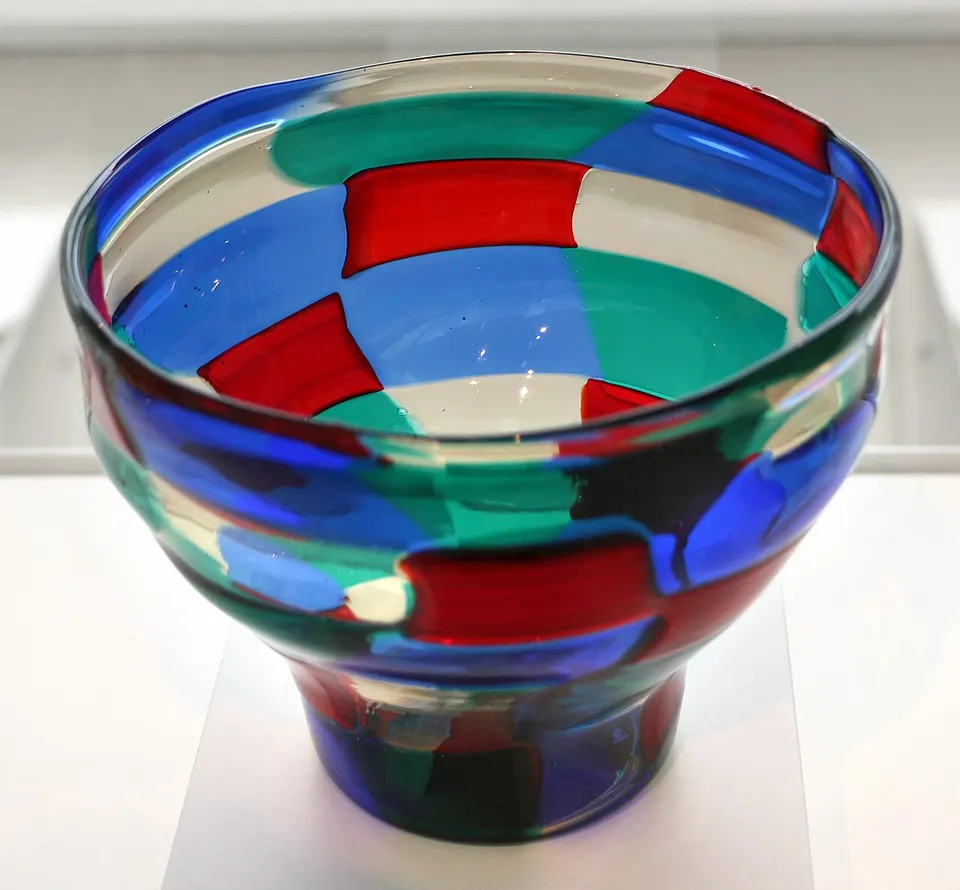
Some series were hard or impossible to repeat. The Metropolitan Museum counts fewer than 20 known pieces of Scarpa's murrine opache, a technique introduced in 1940. Several of them were in its exhibition of nearly 300 works.
Other pieces were made for decades. A model that still sells new is easier to find, even if it carries a famous name. So the year of making counts as well as the design. Numbered editions help: the V&A has Venini goblets by Alessandro Mendini marked XII / XXX.
Technique alone does not make glass rare. See Murano techniques for what each one looks like.
Condition: damage that lowers the value
- Chips on the rim and foot, also small ones you find only with a fingertip.
- Cracks, above all near handles and added parts.
- A cut-down rim. Compare the height with other examples of the same model.
- Glue, filled gaps and ground-off damage. Ask that any restoration is named in the description.
- Haze that does not wash off. It may be decay in the glass itself.
Do not try to improve a piece before it is examined. Polishing and scrubbing remove original surface, and stickers can be lost in the sink. Safe steps are in how to clean Murano glass.
Who can tell you the value
Museums will not. The Corning Museum of Glass gives no money value and no opinion on rarity. It suggests a reliable antique dealer, a photograph sent to an auction house, or a member of a professional group such as the American Society of Appraisers, the Appraisers Association of America or the International Society of Appraisers.
Choose someone who knows Italian glass of the 20th century. Ask for a written opinion that names the maker, the model, the date, the condition and how the comparison was made. Look at sold pieces. An asking price shows only what a seller hopes for.