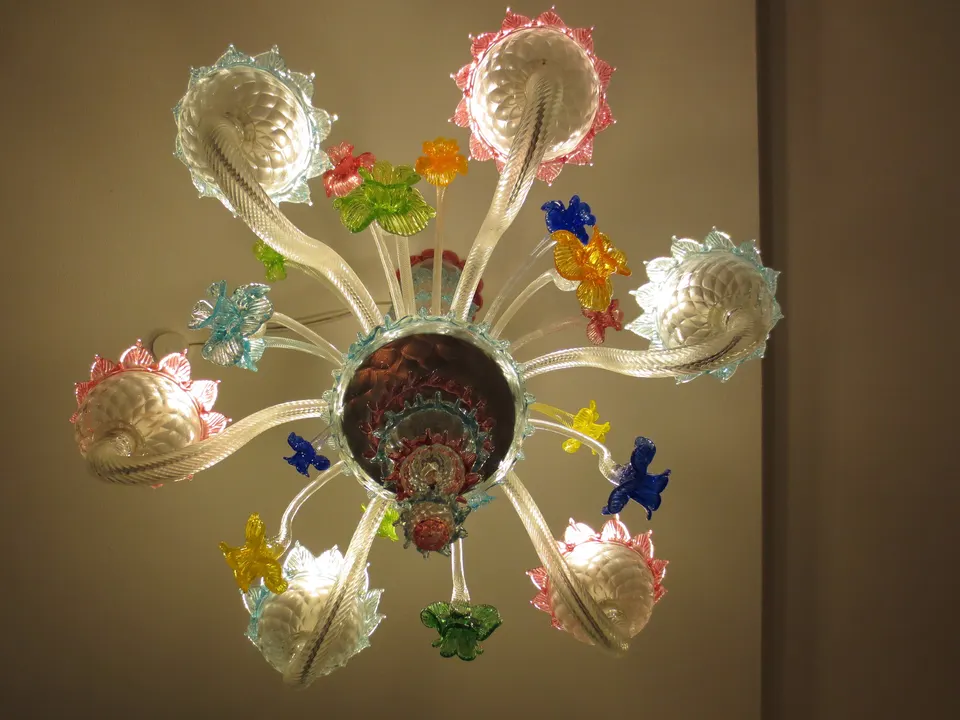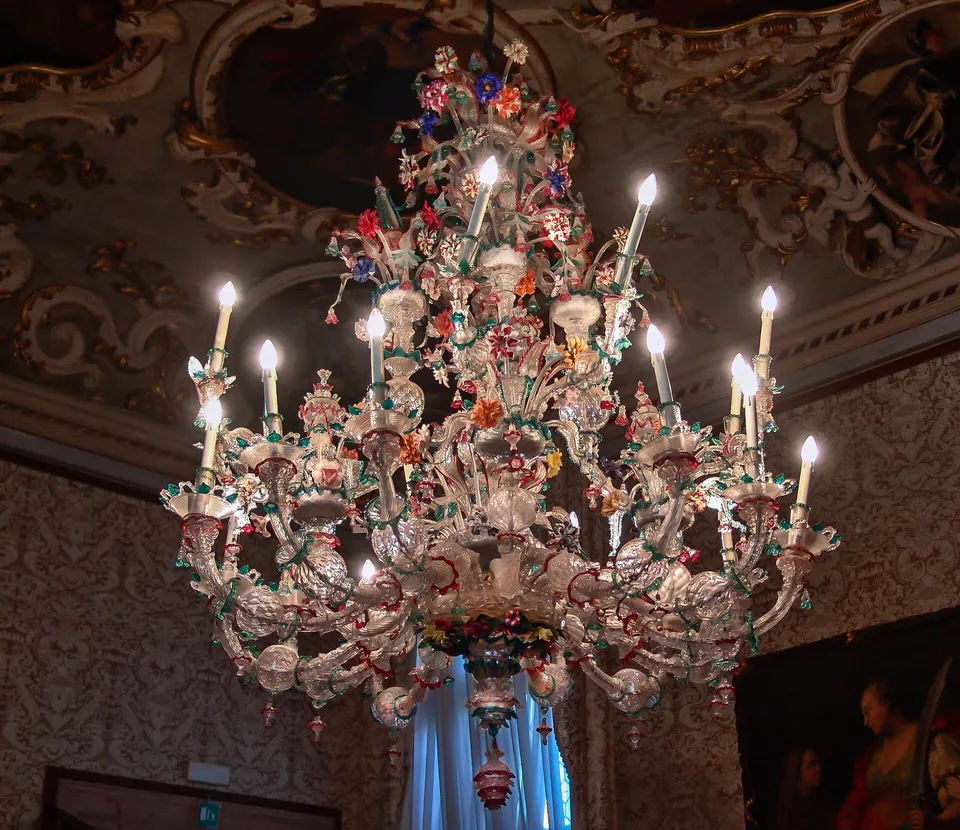
A Murano chandelier is made of many hand-shaped pieces of soda glass, often with leaves and flowers, fixed on a metal frame. It differs from crystal chandeliers, which get their sparkle from cut drops.
What makes a chandelier Murano style
Murano glass is soda glass. It stays soft for a long time when hot, so the maker can twist it into curved arms, leaves and petals. Cold, it is hard and brittle and not good for cutting facets. That is why the old Venetian chandelier shows shape and color, and the English or Bohemian one shows sparkle.
The flower type is called ciocca, Venetian for a bunch of flowers. Smiths made a metal frame. Glassmakers covered it with arms, cups, leaves, fruit and flowers, clear or colored. The middle stays almost empty, because the decoration sits out at the ends of the arms. For the general process see how Murano glass is made.
Murano, English and Bohemian chandeliers compared
| Murano | English cut glass | Bohemian (Maria Theresa) | |
|---|---|---|---|
| Glass | Soda glass | Lead glass | Potash glass |
| Worked | Hot, with tongs | Cold, cut into facets | Molded pieces set along metal arms |
| Arms | Curved glass, or metal covered with glass | Glass, fixed to a metal plate hidden by a bowl | Flat metal bars between strips of glass |
| What you notice | Flowers, leaves, color | Sparkling drops | Glass rosettes along the arms |
Briati and the chandelier in Ca' Rezzonico
Giuseppe Briati, from a Murano family, made crystal in the Bohemian manner and shaped it in a Venetian way. The city museums of Venice name him as the inventor of the ciocca chandelier with its crystal arms and colored flowers. In 1739 Venice let him move his furnace from Murano into the city, a rare permission at that time.
His most famous piece hangs in the Brustolon room of Ca' Rezzonico in Venice. It has twenty lights and dates from around the middle of the 18th century. Very few originals survive. Many chandeliers called Briati today are copies from the late 19th and early 20th centuries.
The museum on Murano shows a giant made in the 1860s by the best furnaces of the island: 60 arms on four levels, about 4 meters high, more than 300 kg.
Modern Murano chandeliers
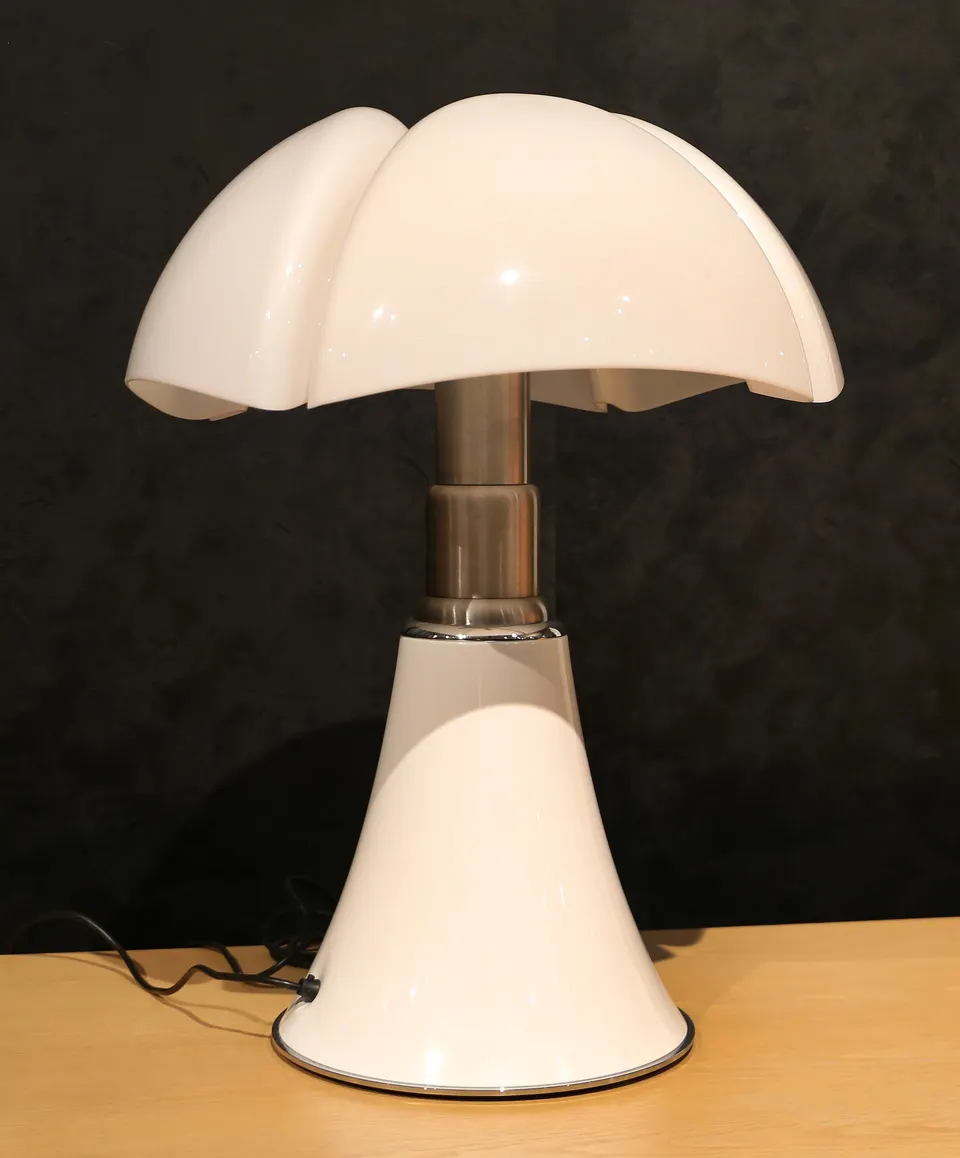
In the 20th century designers also built chandeliers from repeated units. For the Veneto pavilion at the Italia '61 exhibition in Turin, Carlo Scarpa designed a huge Venini chandelier of about 4,000 glass polyhedra. Le Stanze del Vetro in Venice showed it again in a large exhibition about Venini light.
The flower type did not disappear. New chandeliers may look almost the same as those of the 18th and 19th centuries, so style alone does not give you the date. More modern designs are in famous Italian lamps.
Before you hang a glass chandelier
- Weight. Ask for it in kilograms. Conservators say the hook and chain must carry more than the full weight, and an engineer should check the ceiling.
- Wiring. Old candle chandeliers were not made for electricity. Let an electrician and a specialist do it together.
- Order. Photograph and number the parts before anyone takes it down.
- Dust. Choose a place you can reach with a ladder. See how to clean Murano glass.
A label on one part does not cover the rest, because broken arms and flowers are often replaced. Use the same proofs of origin as for vases: signs of real Murano glass.
Sources
Main photo: Murano chandelier in Ca’ Rezzonico, Venice. Photo: Didier Descouens, CC BY-SA 4.0