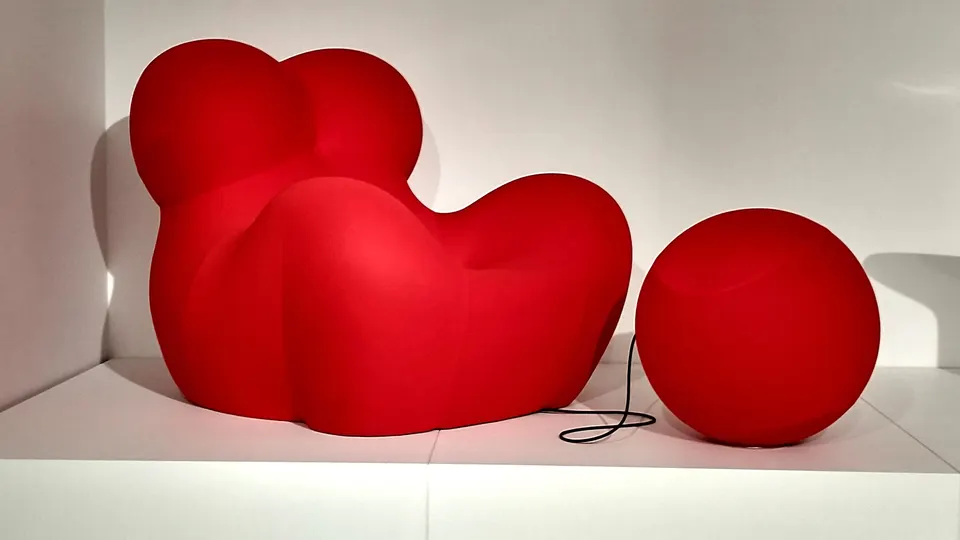
Gaetano Pesce is best known for the Up 5, a round foam armchair tied to a ball. He made furniture and vases from foam, resin and felt, and he wanted pieces from the same mold to come out different from one another.
The Up 5 chair and its ball: meaning and material
Pesce designed the Up series for C&B Italia, today B&B Italia, in 1969. Up 5 is the large armchair, also called Donna or La Mamma. Up 6 is the round footstool. The body is polyurethane foam under stretch jersey, with no frame inside.
The seats were pressed flat and sealed in vacuum packs. When the buyer opened the pack, the foam grew back to full size. The shape recalls a woman's body. Pesce wanted to say something about the position of women: the ball can be seen as a child, or as a prisoner's ball and chain.
Six works by Gaetano Pesce
| Work | What is new in it | How to recognize it |
|---|---|---|
| Up 5 and Up 6, 1969 | Frameless foam, sold flat in a vacuum pack | Rounded armchair with a ball |
| Moloch lamp, 1970 to 1971 | A desk lamp enlarged to the size of a room | Jointed metal arm more than 7 feet tall |
| Tramonto a New York sofa, 1980 | A sofa that pictures a city | Tower-shaped cushions and a sun in red satin |
| Pratt chairs, 1984 | Nine chairs from one mold, from limp to rigid | Mixed colors, hands and a face pressed into the surface |
| I Feltri armchair, Cassina, 1987 | Wool felt made stiff with resin only at the bottom | A thick felt collar you can fold open or closed |
| Crosby child's chair, 1998 | Resin poured into a mold, so each color mix differs | A face cut out of the back, metal rod legs |
Foam, resin and felt: how he used each one
- Foam. In the Up series the material decides the form. Pesce said the Up 3 chair came from thinking about a sponge.
- Resin. It is poured or injected as a liquid, so colors run together in a way nobody fully controls. He used it for chairs, vases, lamps and jewelry.
- Felt. For I Feltri, thick wool felt is soaked in resin in the lower part. The base becomes firm, while the top stays soft. The seat is tied to the body with hemp cord.
Pesce said that the casting methods of the Murano firms Moretti, Vistosi and Venini influenced him when he was a student. The basics are in the article on how Murano glass is made.
Why two Pesce chairs are never the same
Factories normally try to make every piece identical. Pesce asked for the opposite and called his approach a diversified series. The mold stays the same, but the workers change the proportions, the color or the density.
The Pratt chairs, made while he taught at the Pratt Institute in New York, are the clearest example. Each of the nine got a denser resin than the one before. The first could not hold its own shape. The last was so hard that it was uncomfortable.
One such piece is usually enough for a room. Advice on giving it space is in the article on choosing one strong piece.
Life in Venice, Paris and New York
He was born in La Spezia in 1939 and studied architecture in Venice, where Carlo Scarpa was one of his teachers. In 1972 he took part in an exhibition of Italian homes at the Museum of Modern Art in New York, alongside the groups of Italian radical design. After years in Paris he moved to New York in 1983 and died there in 2024.
His buildings include the Organic Building in Osaka, finished in 1993, with plants growing on its walls. For the other names of that period, see the list of famous Italian designers.
Museums with Pesce's furniture
The Museum of Modern Art in New York owns the Up 5 and the Moloch lamp. The Victoria and Albert Museum in London has an Up 3, a Pratt chair and a Crosby child's chair, which is listed as on display at Young V&A. The Philadelphia Museum of Art, the Pompidou in Paris and the Vitra Design Museum also have his work. Rooms change, so check the online catalog first.
Sources
Main photo: Up chair by Gaetano Pesce. Photo: Paul Lowry, CC BY 2.0