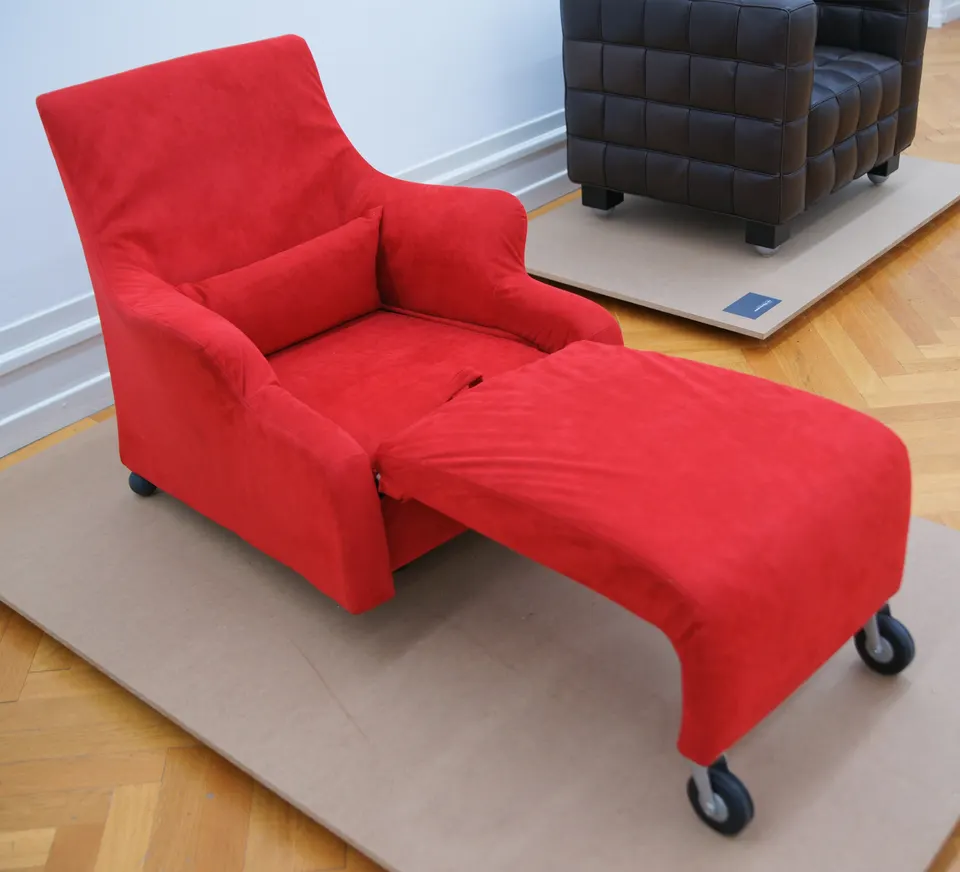
Vico Magistretti designed the Eclisse and Atollo lamps, the plastic Selene chair and the Maralunga sofa with its movable headrest. He was an architect from Milan who liked ideas that could be explained in one sentence.
Furniture and lamps by Magistretti
| Piece | What is new in it | How to recognize it |
|---|---|---|
| Carimate chair, Cassina | A country-style chair made for a modern golf club restaurant | Bright red wooden frame, straw seat |
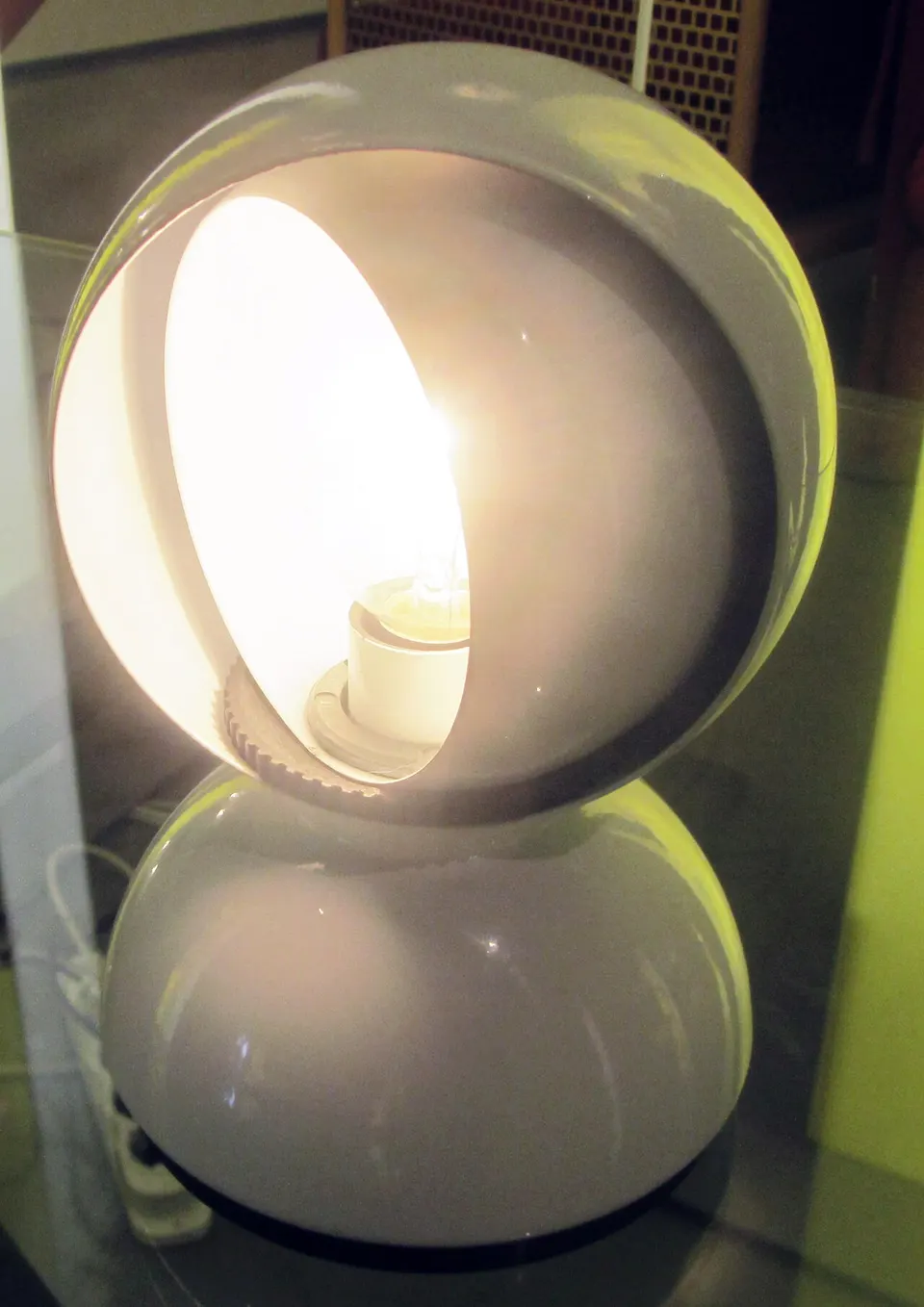
| Eclisse lamp, Artemide | A turning inner shade covers the bulb | Two round metal shades, one inside the other |
| Selene chair, Artemide | Seat, back and legs molded together | Glossy plastic, S-shaped legs, stacks |
| Maralunga sofa, Cassina | A cushion that folds up into a headrest | Low padded back with one or more raised cushions |
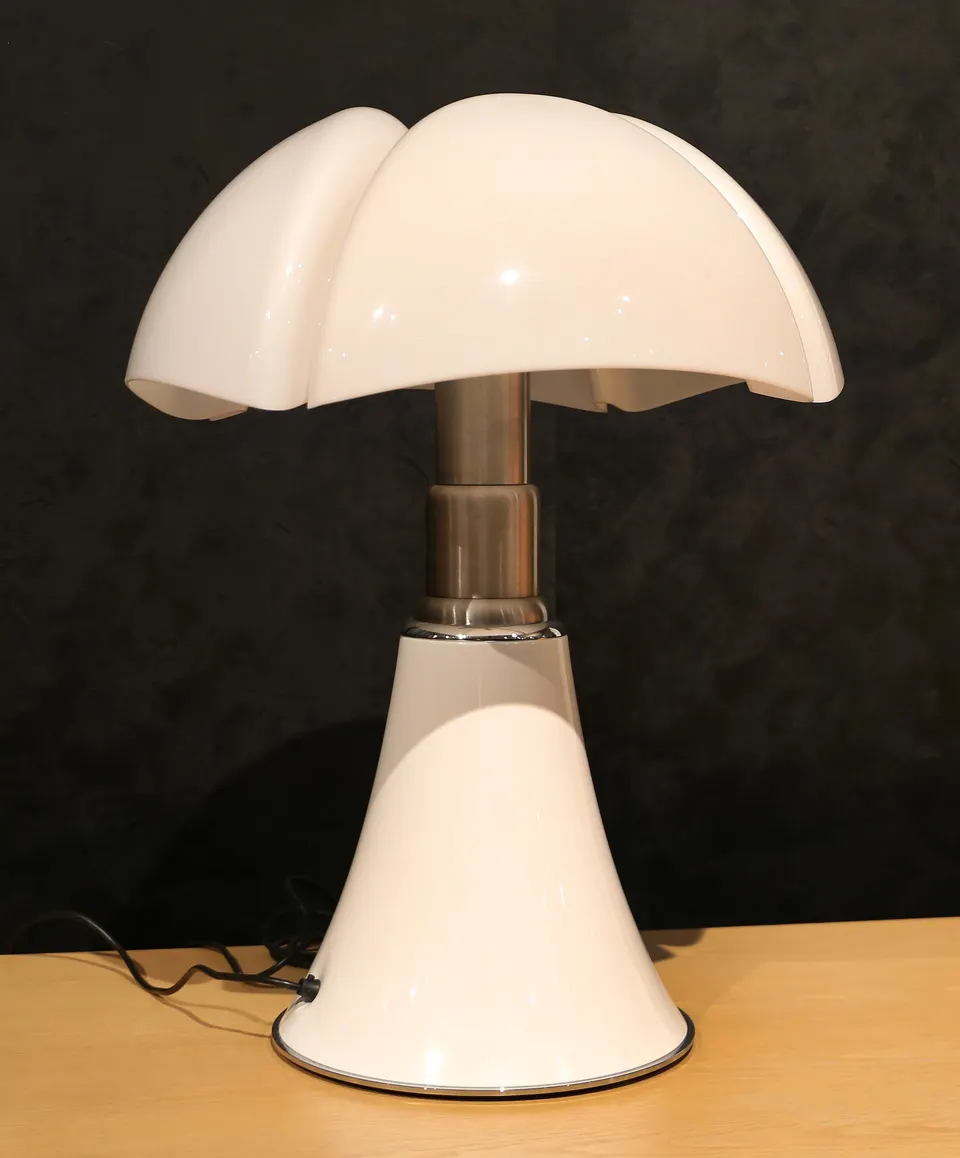
| Atollo lamp, Oluce | A table lamp made of three plain solids | A half-sphere over a cylinder that ends in a cone |
| Nuvola Rossa bookcase, Cassina | Diagonal struts replace the side panels | Six shelves on a folding frame |
The Carimate came first. Magistretti made it for the restaurant of a golf club he designed in Carimate in 1960 with Guido Veneziani. Cassina then put it into production.
Eclisse and Atollo: two ways to control light
The Eclisse, from the 1960s, is named after an eclipse. Its outer shade stays still and the inner one turns in front of the bulb, so the light can be direct or soft. The idea came from a bull's-eye lantern, an old hand lamp. Magistretti joked that his own lamp had left its mark on burnt fingertips, because people turned it by hand. It won the Compasso d'Oro, the main Italian design prize, in 1967.
The Atollo followed in 1977 and won the same prize in 1979. Magistretti described three kinds of light in it: a dark dome that hides the bulb, a very bright cone and a gray base. More lamps of this period are in the guide to famous Italian lamps.
Why the Selene chair has S-shaped legs
A thin flat sheet of plastic bends too easily to carry a person. Magistretti gave each leg a folded section that looks like the letter S when you see it from below. The fold makes the sheet stiff, so the whole chair could be molded as one piece. Only the feet are clipped on.
The Victoria and Albert Museum notes that the glossy surface looks injection-molded, but the chair is compression-molded fiberglass. Artemide made it from 1969 to about 1980. It belongs to the same years of testing new materials as much Italian mid-century modern furniture.
The movable headrest of the Maralunga sofa
The Maralunga appeared in 1973. Its back cushion can be down for a low line or up to support the head. The first mechanism used a bicycle chain, and the current version still has a chain inside the foam. The sofa won the Compasso d'Oro in 1979.
According to a story told by the Triennale museum in Milan, the owner of Cassina punched a prototype he did not like, broke the back and gave Magistretti the idea of movement. If you are trying one out, the same checks apply as for any other good quality sofa.
His method: projects described over the phone
Magistretti was born in Milan in 1920, studied architecture there and died in 2006. He worked in his father's small office with one main assistant. He said he liked design so clear that you do not need to draw it, and that he had passed on many projects by telephone.
He often borrowed a detail from an everyday thing: a lantern for the Eclisse, a bicycle chain for the Maralunga, Japanese egg baskets for his Silver chair. You can compare this with the methods of other famous Italian designers.
Magistretti museum in Milan and other collections
His studio at via Vincenzo Bellini 1 in Milan is now a small museum run by the Vico Magistretti foundation. Visits are by reservation, so check the hours on its site. His pieces are also in the Museum of Modern Art in New York, the Victoria and Albert Museum in London and the Vitra Design Museum in Germany.
Sources
Main photo: Chaise longue by Vico Magistretti. Photo: Sandstein, CC BY 3.0