Gio Ponti was a Milan architect and designer, best known for the Superleggera chair and the Pirelli Tower. He also designed glass, tiles, lamps and cutlery, and ran the magazine Domus for most of his life.
Who was Gio Ponti?
Giovanni Ponti, called Gio, was born in Milan in 1891 and died there in 1979. He graduated in architecture from the Politecnico di Milano in 1921 and taught there from 1936 to 1961. Over about six decades he built more than a hundred buildings.
He started in porcelain. In 1923 the Richard Ginori company made him its artistic director, and in 1925 he won the grand prize for ceramics at the Paris exhibition. He founded Domus in 1928. Through it he showed Italian readers the work of foreign architects and of other famous Italian designers. In 1954 he helped create the Compasso d'Oro award.
Gio Ponti's key works
| Piece | What was new | How to recognize it |
|---|---|---|
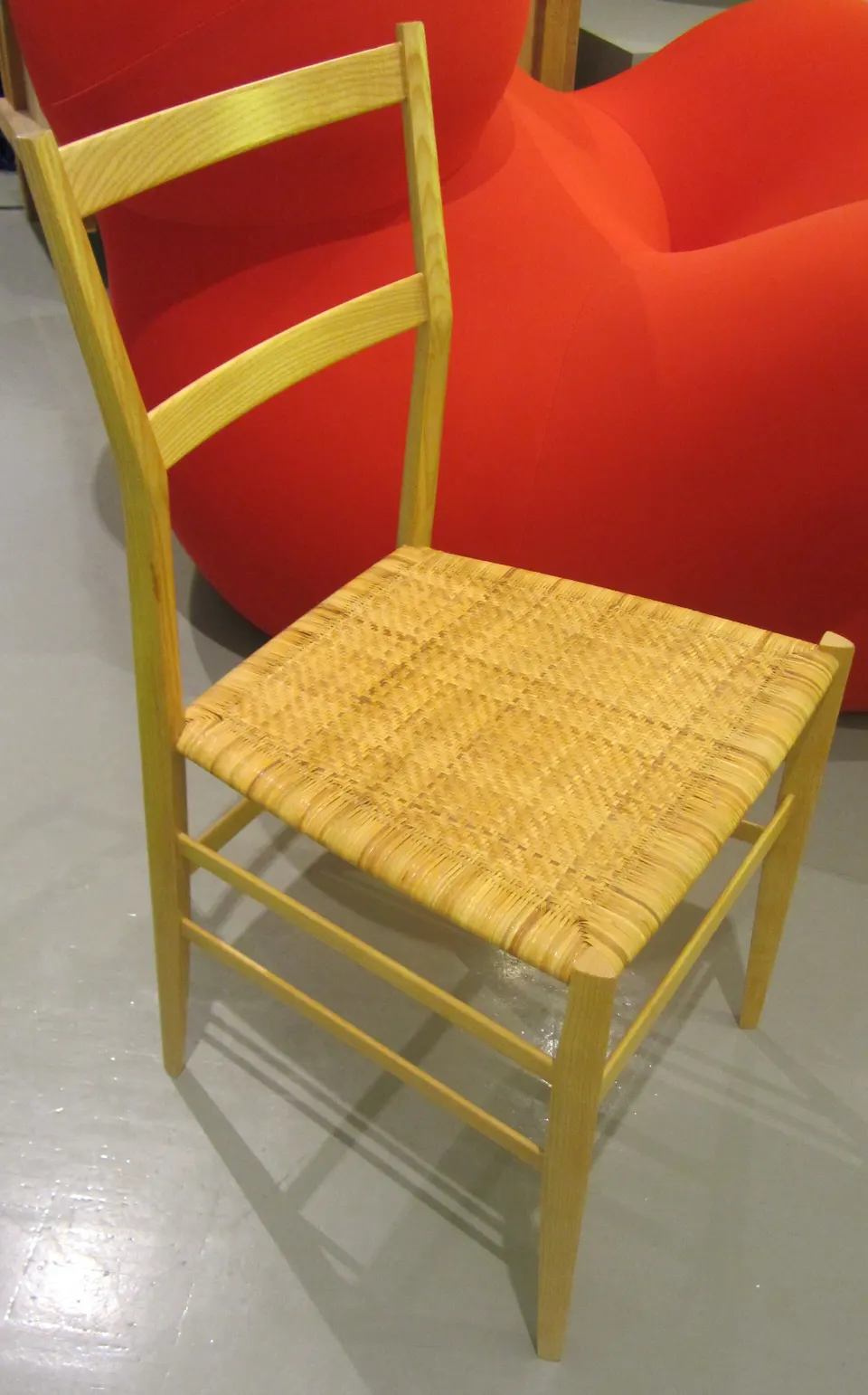
| Superleggera 699, Cassina, 1957 | A full wooden chair of about 1.7 kg | Ladder back, thin ash frame, three-sided legs, woven seat |
| Bottles for Venini, 1946–50 | Bottles drawn like human figures | Outlines that suggest a woman's body |
| Tiles for the Parco dei Principi hotel, Sorrento, early 1960s | Many drawings on one simple format | Square blue tiles, 20 by 20 cm |
| Diamond tiles, Ceramica Joo | Ceramic used to cover whole facades | Diamond shape instead of a square |
| Continuum armchair, Bonacina, 1963 | Rattan in a modern form | The whole chair is rattan |
| Gabriela chair, Walter Ponti, 1971 | A chair planned for small rooms | A seat reduced in size |
Why the Superleggera chair is so light
Ponti took a local chair as his starting point. The town of Chiavari, in Liguria, has made light chairs with ladder backs and woven seats since the 19th century. He removed every bit of wood that the structure did not need.
The result is solid ash joined with dowels. The legs taper toward the floor and are triangular in section, 18 mm at the widest point. According to the V&A, the three-sided leg is what allowed the chair to become so light. The Denver Art Museum gives its weight as 3.75 pounds. Cassina still makes it, with a woven or an upholstered seat.
It is one of the clearest examples of the light frames described in how to recognize modern Italian furniture.
Ponti's main idea: the finished form
In his 1957 book Amate l'architettura, Ponti wrote about the finished form. He meant a shape that is simple and light, with nothing left to add, repeat or extend. The diamond was his favorite example. You can find diamonds and six-sided shapes in his tiles and in the openings of his facades.
He liked working with skilled makers: the enameler Paolo De Poli, the decorator Piero Fornasetti, the Venini glassworks on Murano. The steps behind such glass are explained in how Murano glass is made. He also worked for industry, with an espresso machine for La Pavoni in 1948 and door handles for Olivari. His 1950s chairs belong to the core of Italian mid century modern.
Where to see Ponti's buildings and furniture
- Milan: the Pirelli Tower, built from 1956 to 1960 with the engineer Pier Luigi Nervi, and the church of San Francesco al Fopponino, with its six-sided openings.
- Padua: the Liviano building and the interiors of Palazzo Bo, both at the university.
- Sorrento: the Parco dei Principi hotel, with its blue tiles.
- Caracas: Villa Planchart, where he shaped the house and its rooms as one work.
- London: a Superleggera at the V&A, in the furniture gallery.
- Denver: the art museum building, whose outer walls he designed.
Sources
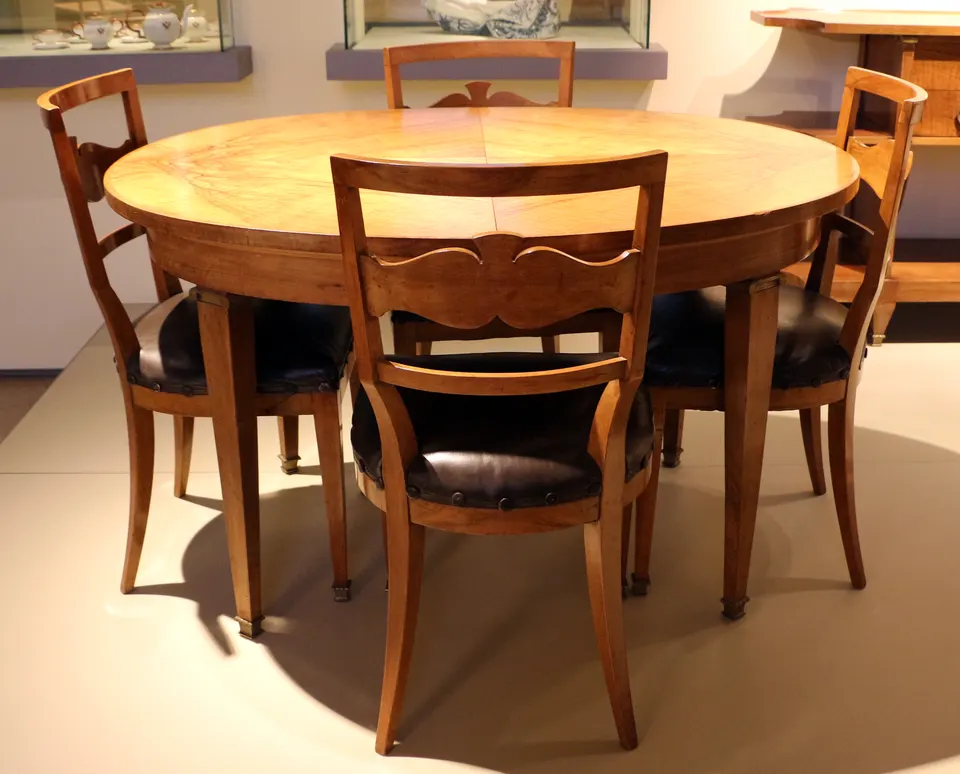
Main photo: Dining room by Gio Ponti and Emilio Lancia. Photo: Sailko, CC BY 3.0