The lattice top
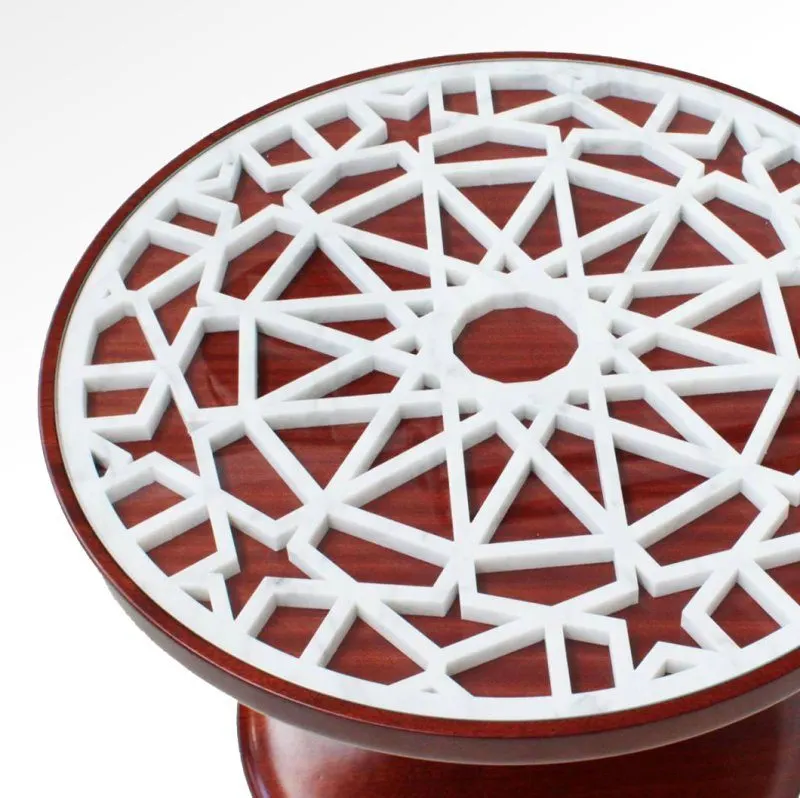
The picture looks down at the top from one side. A wooden rim holds a disk of white, faintly veined stone that appears to be marble, pierced all over. Straight bars leave a small polygon in the middle, cross each other and end in kite-like shapes near the edge. Between the bars you see the wood, with its grain running in one direction. Under the top begins a flaring pedestal.
The drawing recalls the star patterns of Moroccan tile work and pierced stone screens, which may explain the name.
How stone and wood age together
Pierced stone is weak where a bar is narrow and where an inner corner is sharp. In any table of this type, look into the corners and check that the bars keep one width.
Wood moves with humidity and stone hardly does, so an inlay needs a hair of space at the rim. You also want to know if the cells are open or lie under clear glass. The photograph does not settle it. Open cells collect crumbs, and a cup will not stand level over them. If the stone is marble, lemon juice and wine will dull it, so it needs a coaster.
More on both materials: solid wood, veneer, steel and stone.
What to look for
- One bar from the center to the rim, and how many others it crosses.
- The thickness of the stone, visible on the inner faces of the cells.
- The thin line between the stone disk and the wooden rim.