The pattern
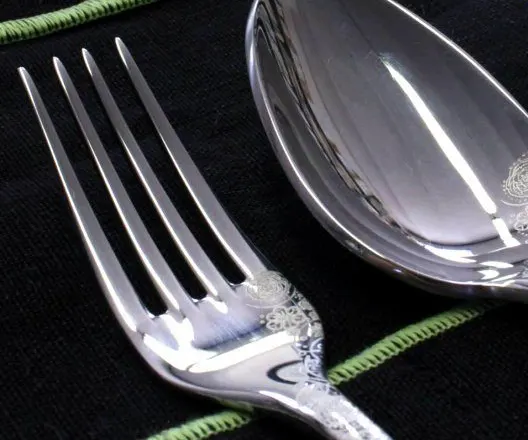
A fork and a spoon lie on black cloth edged with green stitching. Both are plain and mirror-bright for most of their length. The ornament sits where the handle widens: small round flowers and rows of leaves, drawn in thin pale lines. It is placed off center and reaches a little way into the bowl, as though a scrap of lace had been laid on the spoon.
Engraved, stamped or etched: how to tell
A line cut with a tool reflects light from its sides and looks bright. A stamped pattern has rounded edges. Etched or laser lines are usually even in depth and slightly matte. With a magnifier and a lamp you can often tell them apart.
Silverware is also a loose word. In everyday American English it covers any metal cutlery, steel included, and nothing here says which metal was used. On a real piece, turn it over: 925 and 800 are grades of solid silver, while 18/10 describes stainless steel. With no number at all, do not assume solid silver.
Balance a fork on one finger as well. A comfortable one rests near the place where the handle meets the head.
For other finishes, see furniture materials compared.
What to look for
- The ornament ends in mid-air, without a frame around it.
- Four long tines with slim tips and an even gap between them.
- The smooth bowl of the spoon: a dent or wave would break the straight reflection.